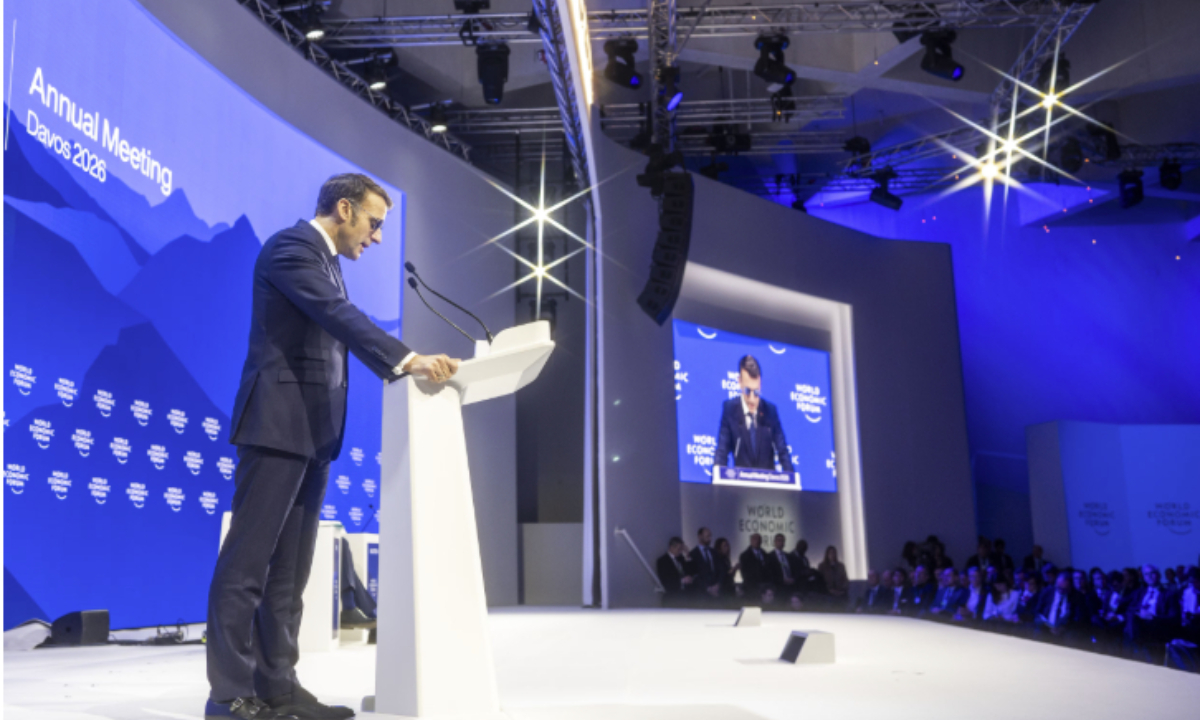
French President Emmanuel Macron has called for an increase in Chinese foreign direct investments (FDIs) in Europe’s key sectors while addressing the World Economic Forum (WEF) Annual Meeting 2026 in Davos, Switzerland. His remarks come at a time when the European Union is reassessing its economic strategy toward China amid rising global trade tensions.
During his speech, Macron stated that China is welcome in Europe, but emphasized that the EU needs more direct Chinese investments rather than a trade relationship dominated by exports into the European market. He stressed that such investments should contribute to Europe’s economic growth, support technology transfer, and comply with European production standards.
Macron highlighted that Europe faces increasing competition from both the United States and China, warning that excessive reliance on subsidized imports could threaten European industrial and commercial sectors. According to him, attracting long-term Chinese investments in strategic industries would help strengthen Europe’s economic resilience.
Macron also sharply criticized US trade policies, condemning the increasing use of tariffs as economic and political leverage. He said that the accumulation of new tariffs is unacceptable, especially when they are used to undermine Europe’s export interests and territorial sovereignty.
Commenting on Macron’s remarks, Jian Junbo, director of the Center for China-Europe Relations at Fudan University, said that the EU has been attempting to rebalance its China policy in response to rising protectionism and growing pressure from the United States.
Jian noted that from China’s perspective, there are no fundamental obstacles to expanding investment in Europe. However, he stressed that Brussels must demonstrate greater sincerity by removing regulatory and political barriers that currently restrict Chinese companies.
Macron’s position aligns with his earlier views published in the Financial Times, where he argued that imposing tariffs or quotas on Chinese imports would be counterproductive and that rebalancing foreign direct investment flows is essential for stable EU-China relations.
Analysts believe that amid intensifying US trade protectionism and geopolitical tensions, Europe and China face shared economic challenges. They argue that abandoning the EU’s so-called “de-risking” strategy and adopting a more pragmatic, long-term approach toward China could encourage greater Chinese investment and deeper cooperation between the two sides.
